Greenhouse Gas Protocol Sharpens Scope 3 and Adds Category 16
The latest GHG Protocol update gives preparers a clearer view of what the Scope 3 revision is starting to prioritise. The draft points to a more prescriptive model for boundaries, data quality and investment-related emissions, even though the current standard remains unchanged for now.
Greenhouse Gas Protocol has published Scope 3 Standard Revisions: Phase 1 Progress Update, a March 2026 paper summarising draft revisions to the Corporate Value Chain (Scope 3) Accounting and Reporting Standard. The paper sets out draft proposals on boundary setting, data quality and investment reporting, indicating the likely direction of the revision.
The central issue in the sources is clearer boundary setting: what companies would have to report, what could remain optional and how that distinction would be disclosed.
The Current Standard And the Update Process
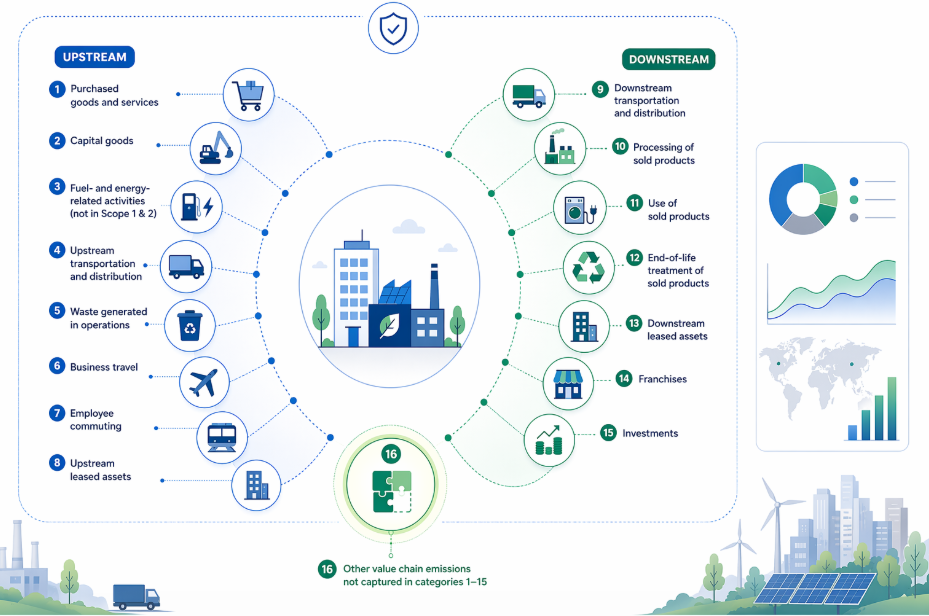
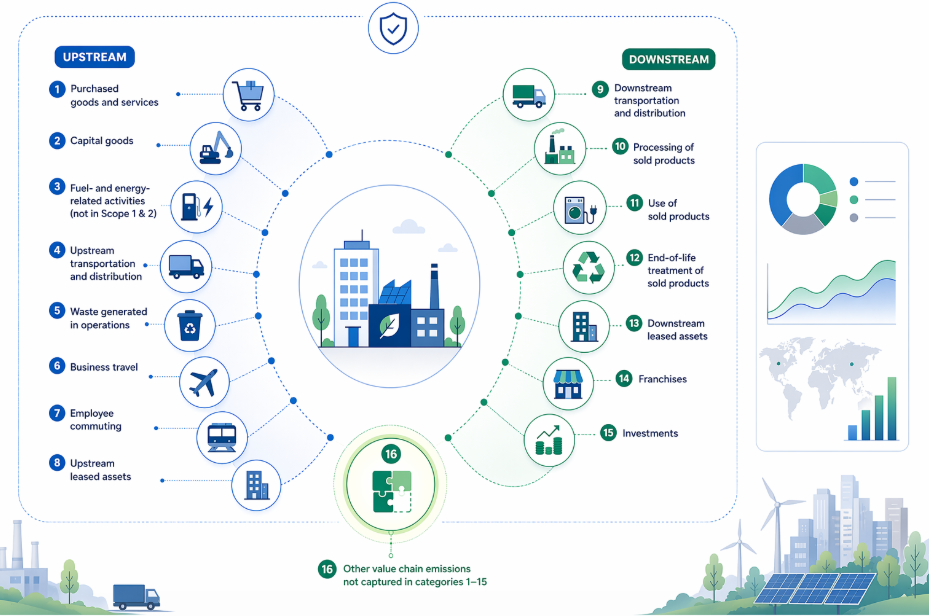
The current Corporate Value Chain (Scope 3) Standard was released in 2011. GHG Protocol describes it as the only internationally accepted method for companies to account for these types of value chain emissions, across 15 upstream and downstream categories.
The new paper sits within the wider revision of the GHG Protocol corporate suite. The process began in 2024, and the progress update says it is being implemented with the International Organization for Standardization (ISO) to produce a harmonised set of international standards for corporate or organisation-level greenhouse gas accounting.
Status and Effect
GHG Protocol says the document was released for transparency after approval by the Independent Standards Board (ISB). Its content remains draft, is subject to change and has not yet entered public consultation, so the existing standards and guidance continue to apply until revised materials are issued.
What Phase 1 Covers
Phase 1 is grouped into three series. Series A covers data quality and related topics. Series B covers boundary setting, including a new category 16 for other value chain activities. Series C covers classification and reporting requirements for investments in category 15.
On data quality, the draft would require Scope 3 emissions to be disaggregated by data type and would introduce reporting on whether Scope 3 data was verified by a third party. The paper also adds draft guidance on emission factors, data-specificity goals and data-quality improvement targets.
On boundaries, the draft would require companies reporting in conformance with the revised standard to account for and report at least 95% of total required Scope 3 emissions. Up to 5% of total required emissions could be excluded, with a de minimis clause inside that threshold. Required and optional emissions would also have to be reported separately. The paper notes that category-specific required and optional boundaries are still being considered in Phase 2.
The proposed new category 16 would cover other value chain activities not captured in categories 1 to 15, including facilitated activities. GHG Protocol links this to business models in which the reporting company earns transactional income without buying, selling or owning the underlying activity. It also says most category 16 sub-categories would be optional and disclosed separately from required Scope 3 emissions, while the full list is still being developed.
Investments and Financial Activities
The draft would also change category 15. According to the paper, category 15 would apply to all companies with investments and to investment managers with discretionary control, not only to financial institutions. All investments listed in category 15 would become required, and the proposed minimum boundary would include an investee’s scope 1, scope 2 and required scope 3 emissions. Companies would also have to disclose the percentage of total carrying value covered by reported category 15 emissions.
At the same time, insurance-associated activities, underwriting, issuance and other financial services would move to category 16 and remain optional under the current draft.
Practical Meaning for Preparers
For preparers, the main practical implication of the draft is classification. The proposals would expand category 15, create category 16 for other value chain activities, including facilitated activities, and draw a clearer distinction between required and optional Scope 3 emissions. If taken forward, that would make classification a key judgement area in determining which emissions fall within required reporting.
The second implication is data and evidence. The proposed model would require disaggregation by data type, disclosure of third-party verification status, justification of exclusions and, for category 15, disclosure of the percentage of total carrying value covered by reported emissions. Where category 16 emissions are reported using third-party standards, frameworks or legislation, the draft also indicates that the methodology source used would need to be disclosed.
The third implication is disclosure structure. Separate reporting of required and optional Scope 3 emissions would place more emphasis on how boundary choices, exclusions and methodological references are presented in disclosure.
What to Watch Next
The next signal will be procedural as well as technical. The March 2026 paper has not yet entered public consultation, so the first point to watch is how these Phase 1 proposals appear in a future consultation draft.
After that, the main watchpoints are the areas the paper itself leaves open: the category-specific required and optional boundaries still being considered in Phase 2, the final definition and sub-categories of category 16, and the final treatment of investments and other financial activities across categories 15 and 16. Until revised standards and guidance are issued, the 2011 Scope 3 Standard continues to apply.